
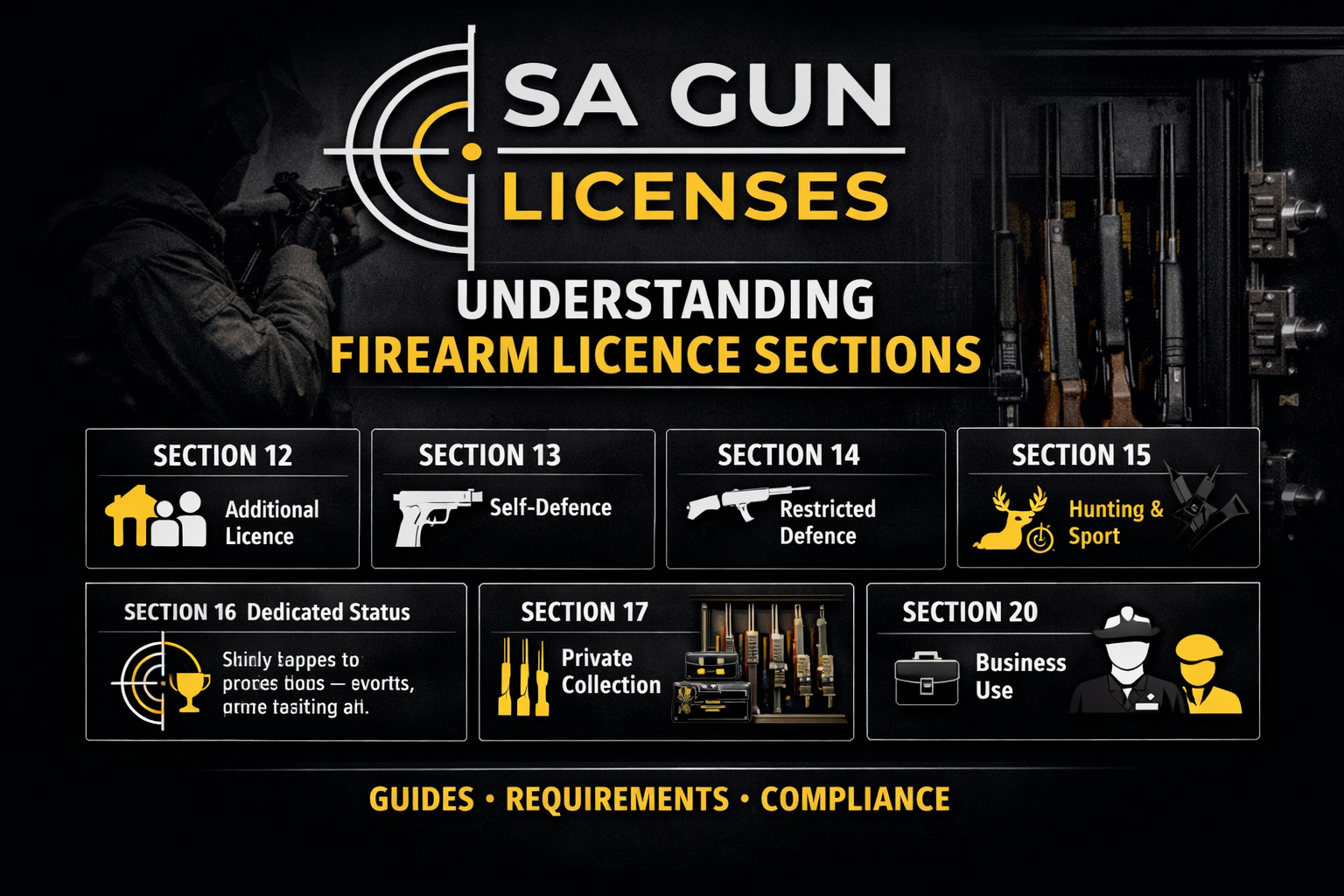
🧾 Section 12: Additional Licence for a Qualifying Person
Cohabitation Rule: The applicant must reside at the exact same physical address as the primary license holder.
Ammunition & Use Pool: Both licensees share the legal ammunition allowance (200 rounds) for that specific firearm. Both individuals have the independent right to possess and use the firearm without the other being present.
Legal Ceiling: An additional license counts directly toward the total number of firearms that the secondary person is legally permitted to license under their name.
Dependency Anchor: The secondary license is directly tied to the primary license. If the primary license expires, is cancelled, or the owner is declared unfit, the Section 12 license immediately lapses. If the additional holder moves out, the card must be surrendered to a Designated Firearms Officer (DFO).
🏠 Section 13: Licence to Possess a Firearm for Self‑Defence
Evidentiary Burden: The SAPS Central Firearms Register (CFR) works on a “need, not right” basis. The motivation must include concrete proof of unique vulnerability, such as local crime statistics, police case numbers (CAS), or business environment risks. Generic statements like “crime is high” result in immediate refusal.
Hardware Restrictions: Limited strictly to one handgun (not capable of fully automatic fire) or one manual shotgun (pump‑action or break‑neck). Semi‑automatic long guns are completely barred.
Logistical Limits: Valid for 5 years. It strictly limits ammunition possession to 200 rounds max per firearm.
Safe Storage: Weapon must be locked in an SABS‑approved safe when not carried on the licensee’s person.
⚠️ Section 14: Licence to Possess a Restricted Firearm for Self‑Defence
Extreme Evidentiary Threshold: The applicant must prove that a Section 13 handgun or manual shotgun is totally inadequate to mitigate their specific threat. This usually requires proof of extreme high‑risk occupations (e.g., high‑value asset transport in private capacity) or recurring, coordinated farm attacks.
Permitted Weapon Types: Semi‑automatic rifles (e.g., AR‑15 platforms) or semi‑automatic shotguns.
SAPS Scrutiny: This is considered an extraordinary civilian license. It carries an abbreviated 2‑year validity period. It triggers intense background checks, lifestyle audits, and physical inspections of storage facilities.
. 🦌 Section 15: Licence for Occasional Hunting and Sports‑Shooting
Participation Threshold: Tailored for individuals who hunt once or twice a year or shoot recreationally without official club standings. Proof requires hunting farm invitation letters, receipts, target sheets signed by range officers, or club event entries.
The “Four Firearm” Cap: An individual may hold a maximum of 4 firearms under Section 15. If you have a Section 13 self‑defence license, you are limited to 3 firearms under Section 15. The collective maximum across both sections cannot exceed 4 weapons.
Prohibited Action Types: Strictly manual operations only (bolt‑action, lever‑action, break‑neck, or pump‑action). Semi‑automatic rifles and semi‑automatic shotguns are completely barred.
Logistical Limits: Valid for 10 years with a strict 200‑round ammunition limit per licensed firearm.
🏅 Section 16: Licence for Dedicated Hunting and Dedicated Sports‑Shooting
Dedicated Status Requirement: The applicant must hold active Dedicated Hunter or Dedicated Sports Person status issued by a SAPS‑accredited association (e.g., SA Hunters or Natshoot). To maintain this status legally, you must log a minimum number of shooting activities annually with your association.
Exemption from Legal Caps: Removes the 4‑firearm civilian ceiling. You can license virtually any number of firearms, provided every single weapon is strictly motivated for a specific, documented sport discipline or hunting category.
Permitted Weapon Types: Opens up the legal acquisition of semi‑automatic rifles and semi‑automatic shotguns.
Ammunition Perks: Valid for 10 years. It completely bypasses the 200‑round storage limit, allowing the possession of unlimited ammunition for the specific calibres licensed under this section.
🤠 Section 16A: Licence for Professional Hunters
Commercial Prerequisite: Restricted to individuals registered as Professional Hunters (PHs), outfitters, or guides with provincial nature conservation authorities.
Operational Motivation: The motivation must prove a commercial need to protect clients from dangerous game or dispatch wounded animals.
Compliance Infrastructure: Valid for 10 years. Applications require active professional association endorsements, business registration documents, and verifiable proof of commercial hunting operations.
🏛️ Section 17: Licence for Private Collections
Accredited Structure: The applicant must be a registered member of an accredited collectors’ association (e.g., the National Arms and Ammunition Collectors Association).
Strict Categorization: Firearm fields are strictly tiered (e.g., Category A, B, or C) based on the historical, technical, or scientific merit of the collection. A collector cannot simply buy random firearms; each piece must fit a pre‑approved “Theme” or “Field of Collection.”
Ammunition Ban: This license explicitly bans the possession of live ammunition for the collected firearms, unless a specific, motivated permit for target testing or exhibition firing is approved by the CFR.
Vault Security: Storage often requires reinforced vaults, alarm linkages, and structural safe rooms rather than basic commercial safes.
🏢 Section 20: Licence for Business Purposes
Corporate Entity Accountability: Issued to juristic persons (registered companies) rather than individuals. The company appoints an official “Responsible Person” who is legally accountable for the inventory.
Use‑Case Segmentation: • Security Providers & Cash‑In‑Transit (CIT): Valid for 5 years. Firearms are strictly for operational duties. Guards must carry a company‑issued permit alongside their personal business‑use competency card. • Game Ranching, Culling & Farming: Valid for 10 years. Issued to commercial game farms for predator control, livestock protection, culling operations, and anti‑poaching units. • Accredited Firearm Training Academies: Valid for 5 years. Firearms are used exclusively on‑range by instructors to train students for civilian or business competencies. • Film, Television & Theatrical Productions: Valid for 2 years. Covers real firearms modified to fire blanks or specialized prop weapons used under the direct supervision of an accredited armourer. • Marine & Aviation Security: Valid for 5 years. Specialized protection details operating on commercial vessels, high‑risk shipping routes, or cargo transport.
Operational Audits: Demands meticulous corporate infrastructure: register books tracking which guard has which weapon, mandatory incident reporting to SAPS within 24 hours of discharge, ballistic testing, and secure central armouries. Firearms are strictly tools of trade and can never be used for private purposes.
Comprehensive guide to South African firearm licence categories under the Firearms Control Act. Learn the differences between Section 12, 13, 14, 15, 16, 16A, 17, and 20 — including requirements, limits, ammunition rules, and compliance obligations.
✅ Conclusion
Each firearm licence section under South African law serves a specific purpose. Whether for self‑defence, hunting, professional use, collections, or business operations, compliance with SAPS and CFR requirements is non‑negotiable.
For expert assistance with firearm licence motivations, SAPS forms, and compliance documentation, contact SA Gun Licenses — your trusted partner in firearm licensing education.